
Sewer Processing Facility & Treatment
The Annville Township Sewer System provides sanitary sewer service to residents and businesses in the Township and ensures wastewater is properly collected and treated before safe return to the environment.
Wastewater Collection Hisotry
The wastewater collection system was constructed in 1967 by the Annville Township Authority. In 1969, the collection system was extended to its present size, approximately 30 miles of gravity fed pipe ranging from 8” to 21”, consisting of approximately 475 Township owned manholes and 30 privately owned manholes (LVC and Stone Hill Village). The collection system flows from the far East end of the Township (3rd Ave area) following the Quittapahilla Creek through the Main Interceptor line all the way to the far West end of town to the Wastewater Treatment Plant. All developed areas of the Township Are served by the collection system, as well as some facilities in North and South Annville.
Also constructed in 1967, the wastewater treatment plant provided secondary treatment by the contact stabilization activated sludge process. The plant was designed to remove 85% of the biochemical oxygen demand (BOD) and suspended solids from 600,000 gallons of wastewater daily. This facility included the plant pumping station, two contact stabilization tanks with aerobic digesters and chlorination compartments, outfall sewer, blower building, control building, and drying beds.
The Pennsylvania Department of Environmental Protection required the Authority to upgrade the degree of treatment; therefore, construction was begun on the new facilities in 1978. The design incorporates all of the existing structures and equipment with the new second-stage aeration tanks,second stage clarifiers, return sludge pumping station, chlorine contact tanks, effluent structure, filter building, backwash storage basins, and chemical addition equipment. The upgrade facility is capable of removing nearly all the BOD and suspending solids and reducing the concentration of phosphorus and the ammonia nitrogen concentrations to 2 mg/L. The design flow was increased to 750,000 gallons.
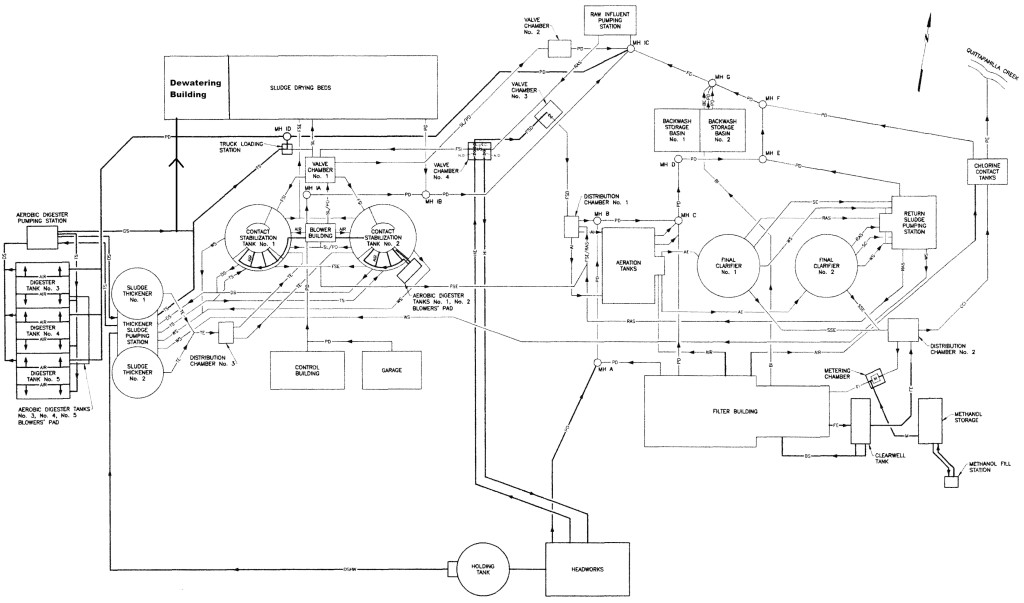
In 2011, construction began on another Pennsylvania Department of Environmental Protection (DEP)mandated Biological Nutrient Removal (BNR) upgrades, largely driven by the Chesapeake Bay TributaryStrategy. These upgrades were required for wastewater treatment plants to meet stringent NPDES permit limits for nitrogen and phosphorus reduction and to comply with 2010 EPA Chesapeake Bay Total Maximum Daily Limit (TMDL) requirements. The upgrades aimed to achieve a 40% reduction in nutrient loading into the Chesapeake Bay.
Along with this construction project, the Township Authority upgraded the pump station, headworks facility (where screening and grit removal occur), as well as a septage receiving station to bring in outside waste into the Wastewater Treatment Plant. With the increase of testing requirements for biosolids and storage due to acceptable time frames for land application, the Authority constructed 3 new aerobic digesters (200,000 gallons each) in order to increase storage and reduce waste volume.
In 2018, due to the lack of land availability for liquid land application of biosolids, the Authority began construction on another plant upgrade. This upgrade included the installation of a centrifuge for dewatering liquid biosolids, the end byproduct of the wastewater taken at the Treatment Plant. With This process, the staff at the Treatment Plant can take liquid biosolids around 2% solids and turn them into a dry “cake” with solids around 22%. Through dewatering, the Township is able to haul the drycake to a farm where the material can be used as fertilizer through the contracted farm management company.
Processing Facility
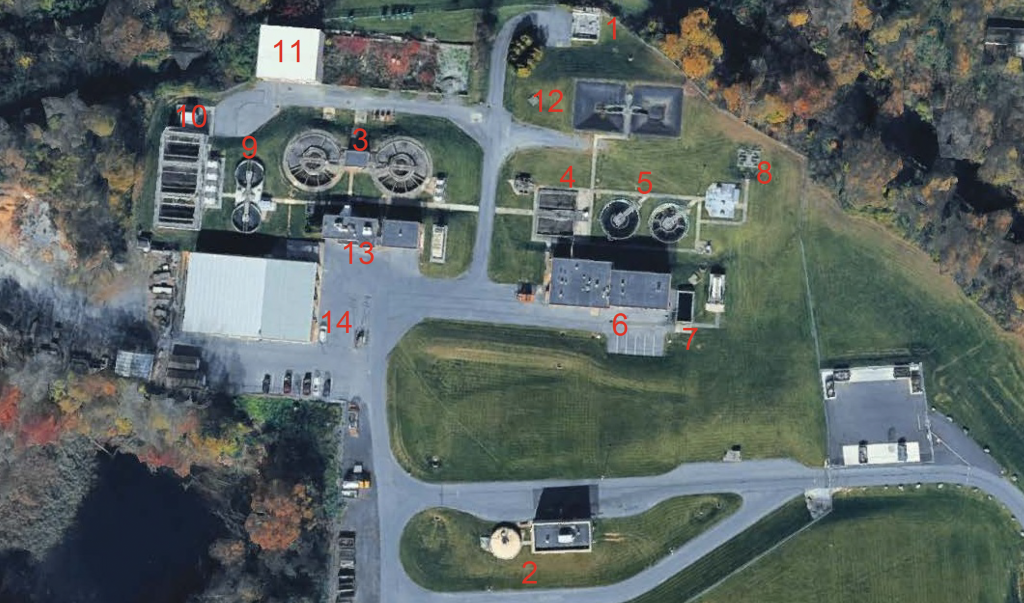
- Influent Pump Station
- Wastewater flows by gravity from the Township through approximately 30 miles of pipe where it is pumped to the Headworks facility.
- Headworks Facility
- This is where the screening process occurs to remove grit/stones and other foreign materials.
- Contact Stabilization Zone/First Stage Clarifiers
- The contact aeration and reaeration tanks mix the wastewater and provide oxygen for the microscopic organisms feeding on the organic portion of the wastewater.
- The biological sludge settles to the bottom of the First Stage Clarifiers and the clear water flows over the weirs to the next treatment stage.
- Second Stage Aeration Tanks
- First stage effluent is mixed and aerated in absence of organic waste. In this environment,microscopic organisms stabilize ammonia and remove nitrogen.
- This is also where Ferric Sulfate is introduced for the removal of Phosphorus compounds (laundry detergents, chemicals, fertilizers, plastics (PFAS)).
- Second Stage Clarifiers
- The biological sludge and phosphorus precipitate settles to the bottom and the clear water flows over the weirs to the BNR (Biological Nutrient Removal) Filters.
- BNR Filters
- This is where methanol is introduced to the wastewater stream as a carbon source for additional removal of nitrogen and phosphorus, as well as filtering through sand filters, all for the requirements to discharge into the Chesapeake Bay Watershed.
- Stilling Well
- A holding tank for water that is used to backwash the BNR filters. All excess waters from this tankare sent to the Chlorine Contact tank for disinfection.
- Chlorine Contact Tank
- This is where the effluent leaves the plant, by first going through its final disinfection (CL2). The Receiving waters for the plant effluent is the Quittapahilla Creek.
- Gravity Thickeners
- All settled waste from both the First and Second Stage Clarifiers are pumped to the Gravity Thickeners. These thickeners settle out the solids once again to achieve maximum solids content,while the clear water flows over the weirs to be introduced back into the process again (3).
- Digesters
- These tanks are used for holding biosolids in order to meet DEP testing requirements.
- Dewatering Building
- This building houses the Centrifuge used to dewater the biosolids held in the Digesters. This process allows liquid biosolids with a solids content of around 2% to be dewatered to a cake of roughly 22%. The final cake material is then hauled to a DEP permitted field to be used as beneficial use for soil by the farm management company.
- Backwash Basins
- All the material from the 3 BNR filters that get each get cleaned 3 times/day is stored and reintroduced into the wastewater stream (1).
- Laboratory
- Annville Township WWTP is an accredited laboratory, able to do almost 90% of DEP required testing.
- Superintendent’s Office and Storage
The facility operates under a National Pollutant Discharge Elimination System (NPDES) Permit (NPDES) issued by the Pennsylvania Department of Environmental Protection.
You can review the full permit here: Annville Township Authority NPDES Permit